mercoledì 26 marzo 2014

Battaglia di Montmirail, 11 febbraio 1814: la Guardia attacca! - Battle of Montmirail: the Old Guard Attacks!!


Nell'ambito delle ricostruzioni per il bicentenario non potevamo trascurare la battaglia di Montmirail, il colpo di coda dell'Imperatore in quella che secondo molti è stata una delle sue  campagna più belle.
Per la partita abbiamo utilizzato, come per Mockern il regolamento Field of Battle2, ma stavolta lo scenario è stato totalmente ideato da noi.

***
   La battaglia di Montmirail venne combattuta nei presi della cittadina di Montmirail l'11 febbraio 1814 nel quadro della campagna dei sei giorni, tra i Francesi comandati dall’Imperatore in persona e l’esercito alleato composto da russi e prussiani.
La battaglia ebbe luogo subito dopo quella di Champaubert, vinta  dalle truppe francesi.
La situazione appare favorevole ai francesi, che per una serie di circostanze legate alle manovre compiute precedentemente dai reparti dell'Armata della Slesia condotta dal feldmaresciallo von Blücher, si trova al centro di un lasco schieramento dei reparti alleati, con la possibilità di attaccarli separatamente e con buone probabilità di successo.
Scale: 1 unità = 800 fanti, 500 cavalieri, o 6-8 cannoni. 1" = circa 35 metri.
Il tavolo misura 180 cm per 180.


Mappa
Terreno:
Il Torrente è di Classe II, ma l’artiglieria può attraversarlo solo sui ponti. I boschi sono di Classe III. I villaggi sono di Classe II.
Scenario per 7 Giocatori
 Francesi
Friant e Nansouty
Ricard
Mortier

ALLEATI
Sacken (2 giocatori)
Yorck (2 Giocatori)


Schieramento iniziale
Rinforzi:
Alleati:
I Prussiani entrano dalla strada a nord.
La 1° Divisione entra  alla 4° carte Movimento alleata.
La 7° Divisione entra alla 5° carta Movimento alleata.

Francesi:
I Francesi entrano dalla strada da Montmirail.
La 2° Divisione della Guardia entra alla 2° carta Movimento Francese.
La cavalleria entra alla 3° carta Movimento francese.

Vittoria:
I Giocatori sommano ai propri punti Morale d’esercito i seguenti punti quando controllano i relativi obiettivi e li sottraggono quando li perdono o li abbandonano (messi in rotta o eliminati).
Marchais                                                                                                8 MP
Haute-Epine                                                                                          4  MP
Fontanelle                                                                                              4 MP
Incrocio tra la strada da Fontanelle e la strada Parigi-Montmirail             4 MP

 Considerare la carta “Movimento di un Gruppo” come Movimento di una Divisione . Gli Alleati potranno muovere una Divisione ciascuno.  
Comandanti di Corpo: Dove presenti, possono lanciare il proprio LD se quello lanciato da uno dei suoi Comandanti subordinati non è stato favorevole, per ogni carta “Movimento” o “Movimento di un Raggruppamento”. This does not subject the Corps commander to a Survival Test.

Regola particolare per il Morale degli Alleati:
All’apparizione della Carta “Morale” gli eserciti che hanno 0 Punti di Morale, considerando  separatamente Prussiani e Russi, effettuano il test di Morale.
Chi lo fallisce si ritira verso la propria linea di comunicazione a velocità massima alla prima opportunità e non può iniziare mischie o recuperare punti Morale. Tutte le unità sono considerate Out of Command e quelle che già lo erano vengono rimosse immediatamente dal gioco.
Se sia i Prussiani che i Russi hanno 0 Punti Morale, all’apparizione della Carta Morale, effettuare il Morale come nelle regole normali.

Ordini di battaglia

 **********
 As a part of the reconstructions for the bicentenary we could not ignore the battle of Montmirail, the sting in the tail of the Emperor in what, according to many was one of his most beautiful countryside .For the game we used, as for Möckern Field of Battle2 rules, but this time the scenario was completely designed by us.

   The Battle of Montmirail was fought in the town of Montmirail on February 11, 1814 during the campaign of six days, between the French commanded by the Emperor and the allied army composed of Russians and Prussians.The battle took place immediately after that of Champaubert, won by French troops.The situation appears favorable to the French, who for a variety of circumstances related to the maneuvers carried out previously by the army of Silesia led by Field Marshal von Blücher, is at the center of a loose array of allied units, with the ability to attack them separately and with a good chance of success.Scale : 1 unit = 800 infantry, 500 cavalry, or 6-8 cannons. 1 "= 35 meters .The table measures 180 cm by 180 . (scale 15 mm)

General map of the area: in green square, the table

Terrain:
The Stream is a Class II, but the artillery can only cross it on bridge. The woods are Class III. The villages are Class II.
 
Scenario for 7 Players  
French
Friant and Nansouty
Ricard
Mortier

Allies
Sacken (2 players)
Yorck (2 Players)

Reinforcements:Allies:The Prussians enter from the road to the north.The 1st Division enter at the 4th Allied Movement card .The 7th Division enter at the Allied Movement 5th card .French :The French enter from the road from Montmirail .The 2nd Division of the Guard enters at the 2nd Movement French card.The cavalry enters at the 3rd Movement French card. 
Victoria :Players add up their points Moral of army the following points when control its goals and subtract them when they lose them or abandon them ( routed or deleted ) .Marchais 8 MPHaute Epine 4 - MPFontanelle 4 MPCrossroads between the road from Fontanelle and the road  Paris-Montmirail 4 - MP 

Special rules:
Consider the card "Move a Group " as a movement of a Division. The Allies will be able to move one division each.Corps Commanders : where present, may throw their own LD if the result of  one of his subordinate commanders was not favorable, for each " Movement " or " Movement of a grouping ." This does not subject the Corps Commander to a Survival TestSpecial rule for the morale of the Allies :At the appearance of the "Army Morale" card only the armies that have 0
Army Morale Points, considering separately the Prussians and Russians, make the test.Who fails, withdraw  toward its line of communication at maximum speed at the earliest opportunity and may not start melee or recover Morale points . All units are considered Out of Command and those who already are  OOC are immediately removed from the game.If both the Prussians and Russians have 0 Army Morale Points,  test as per normal rules .

OOB


sabato 16 novembre 2013

Un anno dopo: Mockern/Lipsia - A year later: Mockern/Leipzig

Dopo un anno dalla grande battaglia, un'altra rievocazione per il bicentenario di quella che fu il più grande scontro dell'epoca napoleonica, la battaglia delle Nazioni, Lipsia.
Però l'intera battaglia l'avevamo già ricostruita oltre 12 anni fa, con uno sforzo enorme... Allora, stavolta abbiamo deciso di limitarci al settore settentrionale dell'intera battaglia, quello che vide coinvolta l'Armata del Nord, formata da Prussiani e Russi, opposta ad alcuni Corpi Francesi, sotto il comando dei marescialli Mortier e Ney.
Nella realtà fu un disastro per i francesi, oggi, invece, la storia è cambiata...
Come regolamento è stato scelto, per vari motivi, Field of Battle 2, un regolamento card driven che ha parecchi meriti: è facilissimo da imparare in pochi minuti, è molto intelligente, i risultati di simulazione sono a mio parere ottimi ed è molto coinvolgente, senza tempi morti per nessuno dei giocatori. In più è supportatissimo da parecchi blog tra i quali merita senz'altro di essere citato "Blunders on the Danube" dal quale lo scenario è stato completamente tratto (ed è un bel vantaggio...) e per il quale ringrazio l'autore, Peter, per i chiarimenti in merito...

Lo scenario è durato due serate ed ha convolto 9 giocatori. Il risultato è stato una chiara vittoria francese, perchè non siolo gli alleati hanno subito forti perdite, ma non sono riusciti neanche a conquistare nessuno degli obiettivi assegnati. E' mancato soprattutto  il coordinamento tra le armi e la cavalleria, quella prussiana, i particolare, è stata distrutta senza aver ottenuto alcun vantaggio decisivo.
Comunque lo scenario è stato molto divertente ed i giocatori (almeno la maggior parte di loro) è rimasta soddisfatta...

******

One year after the great battle , here are again for the bicentennial commemoration of what was the largest battle of the Napoleonic era , the Battle of the Nations , Leipzig.But  we had already rebuilt the whole battle about 12 years ago , with a huge effort ... So this time we decided to limit ourselves to the northern sector of the battle , what he saw involved the Army of the North , formed by the Prussians and Russians , as opposed to some French Corps , under the command of Marshals Ney and Mortier .In reality it was a disaster for the French today, however, the story has changed ...As rules  we have chosen Field of Battle 2, a regulation driven card which has several merits : it is easy to learn in a few minutes , is very smart, simulation results are excellent IMHO and it is very addictive , no downtime for all players . More, it has support from several blogs, including well worth to be mentioned " Blunders on the Danube " from which the scenario was completely taken (and it is a great advantage ... ) and for which I wish to thank the author, Peter, for clarification about the scenario.

We had 9 players and the game lasted two nights: the result has been a clear victory for the French army, because the Allies did not succed in conquer none of the objectives and had very strong casualties. They faulted in coordinating the assaults and saw all their cavalry destroyed without any decisive advantages.
The game has been very fun and all the players (or at least a large part of them) enjoyed it.


Al centro del campo di battaglia i francesi sotto pressione, ma per gli Alleati è troppo tardi/ In the central area of the battlefield., the French are uner pressure, but for the Allied is too late...


La cavalleria prussiana si infila in un cul-de-sac.../ Prussian cavalry reserve runs in a cul-de-sac..


... e non ne rimane che un reggimento di Dragoni/... and all that remains is a battered  Dragoon Rgt.

martedì 30 ottobre 2012

La grande battaglia: il Battle Report

Quando una simulazione finisce in maniera assai simile a come sono andate le cose nella realtà si può essere abbastanza soddisfatti. È proprio questo il caso della "tre giorni" svoltasi al Miles Gloriosus per ricostruire la battaglia di Borodino. Infatti, nel tardo pomeriggio di domenica, benché non si sia riuscito ad effettuare tutte le mosse previste, raggiunta la mossa relativa alla tarda mattinata, i francesi  erano in possesso della Grande Ridotta e delle Fleches, dopo aver occupato i resti fumanti del villaggio di Borodino. I comandanti russi, a quel punto, ritenevano opportuno ritirarsi lasciando buona parte dell'esercito ancora intatto, nonostante le serie perdite subite, soprattutto da parte delle artiglierie.

 When a simulation ends in a manner very similar to the way the things went in reality, it can be quite satisfying. This is exactly the case of the "three days" held at Miles Gloriosus to reconstruct the battle of Borodino. In fact, in the late afternoon on Sunday, although it was impossible  to complete all the planned moves, the French were in possession of the Great Redoubt and Fleches, after occupying the smoking remains of the village of Borodino . The Russian commanders, at that point, saw fit to withdraw, leaving a large part of the army still intact, despite the serious losses, especially on the artillery.
La situazione all'inizio della battaglia. In Blu le linee francesi, in Verde quelle russe. Nei cerchi rossi, dall'alto in basso, Utitza, le Fleches, la Grande Ridotta, Borodino. - At the start of the battle: In Blu, the French line, in green the Russian line. In the red circles, Utitza, the Fleches, the Great Redoubt and Borodino village
Il bombardamento di Borodino
Ma andiamo per ordine: alle 6.00 del mattino inizia un fortissimo cannoneggiamento nel settore centrale del campo di battaglia e contro il villaggio di Borodino, mentre il Corpo Westphaliano, appoggiato da una brigata della Legione della Vistola, inizia a marciare sul villaggio di Utitza, lungo la strada tra gli estesi boschi.

La Grand Batterie francese contro le Fleches
 First things first: at 6.00 in the morning a tremendous cannonade begins in the central sector of the battlefield and on the village of Borodino, while the Westphalian Corps, supported by a brigade of the Vistula Legion, began to march on the village of Utitza along the way through the woods.


Ma l'attacco su Utitza è solo un diversivo: l'imperatore intende attaccare il centro russo con i corpi di Ney e Davout, appoggiati da un corpo di cavalleria pesante, mentre tenta l'assalto a Borodino e Gorkij con Eugene e Poniatowski. Due corpi di cavalleria andranno a minacciare l'etrema ala destra russa, per tagliare la linea di ritirata lungo la vecchia strada di Mosca. la Guardia, tenuta ovviamente in riserva, servirà per lanciare l'attacco risolutivo sulla Grande Ridotta, cerniera delle due ali della I Armata Russa.
La principale linea difensiva russa, tra la Grande Ridotta, Semenovskaya e le Fleches - Main Russian defensive line, between the Great Redoubt, Semenovskaya and the Fleches

But the attack on Utitza is just a diversion: the Emperor intends to  attack the Russian center with the Corps of Ney and Davout, supported by a Corps of heavy cavalry, while he'll  try to assault at Borodino and Gorkij with Eugene and Poniatowski. Two corps of cavalry will threaten the Russian extreme-right wing to cut the line of retreat along the old road to Moscow. Guard, held in reserve, of course, will be used to launch the decisive attack on the Great Redoubt, that hinge the two wings of the Russian Army.


Borodino sotto attacco
Le prime mosse sono caratterizzate da un potente cannoneggiamento da ambedue le parti, al termine del quale i francesi lanciano l'attacco sul centro russo, mentre Eugene occupa quel che rimane del villaggio di Borodino. Da qui, rischierate le proprie batterie, sarà una vera e propria spina nel fianco del dispositivo russo schierato a difesa della destra della Grande Ridotta.

The first moves are characterized by a powerful cannonade by both sides, after which the French launch an attack on the Russian center, and Eugene occupies what remains of the village of Borodino. From here,  his batteries will be a real thorn in the side of the Russian device deployed in defense of right of the Great Redoubt.


Eugene occupa Borodino
Tuttavia, non tutto va per il meglio per i Francesi; l'attacco su Utitza è messo sotto scacco dalle divisioni della II Armata russa e persino dai cosacchi che, spuntando dai boschi, infliggono pesanti perdite alla cavalleria Westfaliana.

I combattimenti nella valle di Utitza - Fightings in the Utitza valley
However, not everything goes well for the French; the attack on Utitza is put in check by the divisions of the Second Russian Army, and even the Cossacks, popping up from the woods, inflicting heavy losses to the Westphalian cavalry.

Sull'ala sinistra francese, l'aggiramento da parte dei Corpi di Cavalleria della Riserva francese procede con qualche difficoltà causata dal terreno difficile e dal numero di unità; quando si arriva allo scontro con la cavalleria russa, non sempre i francesi hanno la meglio. Anzi, una piccola brigata di corazzieri, vedendo dei Dragoni russi travolgere una Brigata di cavalleria leggera, sono presi dal panico e fugge!
Tuttavia il peso numerico dei cavalieri francesi da questa parte del campo di battaglia è impressionante.

On the left wing French,  the Reserve Cavalry Corps proceed with some difficulty caused by the difficult terrain and tby he number of units, and when it comes into conflict with the Russian cavalry, the French do not always have the upper hand. Indeed, a small brigade of cuirassiers, seeing the Dragons Russians overwhelming a brigade of light cavalry, are panicked and fled!
However, the numerical weight of the French knights from this side of the battlefield is awesome.

Spericolate acrobazie da parte dei Corazzieri Russi!!  
Daredevil stunts by the Russian Cuirassiers!

Il grande attacco francese (Ney e Davout) contro le Fleches ed il centro Russo -
The great french assault (Ney and Davout) on Fleches and the Russian center
Al centro, dopo furibondi combattimenti, le Fleches sono prese e perdute più volte. Addirittura due cariche da parte dei Corazzieri russi riescono a respingere almeno per un pò di tempo, l'avanzata francese ed a catturare alcune batterie nemiche. Ma, alla fine della giornata, le ridotte saranno saldamente nelle mani dei francesi.
Il villaggio di Gorkij, con il comando supremo russo - 
The village of Gorkij, with Russian Headquarters.

In the central sector, after furious fightings, the Fleches are taken and lost several times. Even two charges by the Russian Cuirassiers succeed in repelling, for some time, the French advance and capturing some enemy batteries. But at the end of the day, the redoubt  will be firmly in the hands of the French.

Il Corpo Polacco di Poniatowski lancia l'attacco al ponte di Borodino e, dopo una lotta senza quartiere lo conquista.

Poniatowski's Polish Corps  launches the attack on the bridge of Borodino, and gain it after a fight to the death.

E' il momento decisivo: considerate le perdite subite dagli occupanti della Grande Ridotta, i francesi lanciano la Guardia ed una Divisione di cavalleria all'attacco ed occupano la potente fortificazione.
La Guardia all'attacco della Grande Ridotta -  
The Old Guard attacks the Great Redoubt!

And 'the decisive moment: considered the heavy losses suffered by the occupants of the Great Redoubt, the French launch the Old Guard and a Cavalry Division to attack and occupy the powerful fortification.

A questo punto, perduta la principale linea difensiva e con la vecchia strada di Mosca minacciata dal nemico, per i Russi è arrivato il momento di ritirarsi, risparmiando così buona parte dell'esercito per una prossima rivincita!
Magra consolazione, il villaggio di Utitza è ancora in loro mani così come la nuova strada per Mosca.

At this point, lost their main defensive line and with the old road of Moscow threatened by the enemy, the Russians it'is time to retire, thus saving a large part of the army for an upcoming rematch!

Small consolation, the village of Utitza is still in their hands as well as the new road to Moscow.


Le perdite: per i Russi, circa 23.000 uomini e 200 cannoni. Per i francesi, circa 10.000 uomini e 170 cannoni.

Per entrambe le parti, sono molto meno di quante nella realtà, ma questa battaglia è durata molto meno.


The losses for the Russians, about 23,000 men and 200 guns. For the French, about 10,000 men and 170 guns.For both sides, are much less than in reality, but this battle has been much shorter.


Le riserve russe - Russian reserves
Ha scritto Raffaele, uno dei giocatori "francesi": "Il mio pensiero va a tutti quei valorosi che combatterono in quella battaglia, perchè veramente da dove la si voleva guardare, ovunque c'erano morti su morti, su posizioni bene difese e continuamente aggredite inutilmente, all'unico scopo di vedere chi finiva prima gli uomini.....meno male che a noi tocca solo ricreare quelle situazioni. Ho visto fare cose ai soldatini in questa battaglia , che noi di oggi non possiamo neanche immaginare: assalti ai bastioni della ridotta, difese da enormi batterie di cannoni fumanti, inutili assalti alla baionetta contro interminabili file di avversari. Cariche e controcariche di cavalleria che assomigliavano a serpenti che si contorcevano uno all'altro senza piu' capire chi aveva caricato cosa. E' tutto questo è accaduto solo per la vanagloria di qualche uomo.
Speriamo solo di non dover mai partecipare attivamente a cose come queste, ma speriamo di continuare a giocarle all'infinito, prima di arrivare ad incontrare tutti questi personaggi nei campi elisi."


Ben detto, Raf...

Raffaele, one of the "French" players, wrote: "My thoughts go to all those brave men who fought in that battle, because whereveryou watch there were dead on positions defended well and attacked continuously in vain, for the sole purpose of seeing who ran out before the men ..... thank goodness, it si to us just to recreate those situations. I've seen them do things in this battle, we can not even imagine today: attacks on bastions of the redoubt, defended by huge smoking gun batteries, unnecessary attacks with the bayonet against an endless array of opponents, charges and countercharges of chivalry that looked like snakes writhing together without figure out who had loaded it. And all this only happened for the vainglory of some man.
Let's just hope we never have to actively participate in things like this, but we hope to continue to play them forever, before we get to meet all these people in the Elysian fields."

Well said, Raf...
Tutti amici durante il rancio comune-
All are friends during the common lunch


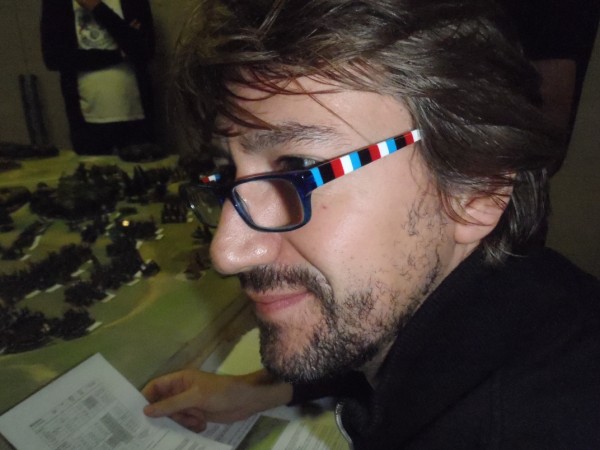
Questi eccentrici Francesi! - Strange French glasses!


A fine battaglia: in azzurro la linea iniziale di schieramento francese, in blu quella finale. In verde la linea difensiva russa. Nei cerchi in rosso, da sinistra, Borodino, la Grande Ridotta e le Fleches
At the end of the battle: in light blu the start line of the French, in blu the final position. In green the Russian defensive line. In the center, the Great Redoubt. 


Le squadre: a sinistra i russi e, a destra, i francesi (con l'arbitro)-
The teams: on the left, the Russian, on the right, the French (and the Umpire)


Un grazie va a tutti i membri del Miles che hanno partecipato alla battaglia (Francesi: Arcangelo, Giuseppe, Andrea, Raffaele, Marco Valerio, Alessandro; Russi: Falco, Angelo, Claudio, Stefano, Giorgio, Juan, Daniele, Bruno, Toni), molti dei quali hanno anche messo a disposizione le proprie miniature (per questo, grazie anche a Massimiliano).
Un ringraziamento particolare va a Claudio, che ha partecipato alla realizzazione del diorama di gioco ed ad Andrea che ha curato la logistica del momento piú delicato delle giornate di gioco, quello del rancio.

                                                                       ****

Qui termina la storia di questo progetto che ci ha impegnato per circa due anni di lavoro di ricerca, sperimentazione, studio, pittura: penso ne sia valsa la pena.
E qui termina pertanto anche questo blog; grazie di cuore a chi ci ha seguito ed apprezzato in tutto il mondo.

Per altre foto della battaglia:
http://www.milesgloriosus.it/photogallery/Borodino2012/Borodino.html


 A thanks goes to all the members of Miles who participated in the battle (French: Arcangelo, Giuseppe, Andrea, Raffaele,Marco Valerio, Alessandro; Russian: Falco, Angelo, Claudio, Stefano, Giorgio, Juan, Daniele, Bruno, Toni). Many of them have also made ​​available their own miniatures (for this, thanks to Massimiliano).

A special thanks goes to Claudio, who has participated in the creation of the diorama of the game and to Andrea who oversaw the logistics of the moment more delicate on matchdays, that of rations.

                                                                       ***
Here ends the story of this project we worked on it for about two years of research, experimentation, study and painting: I think it was worth it.

And so here ends this blog, thank you to those who have followed and appreciated all over the world.


More images from the battlefield:

http://www.milesgloriosus.it/photogallery/Borodino2012/Borodino.html